

Original MRR 60 | Rack with Smith Machine & Cable Crossover Stacks

An all-in-one home gym on the footprint of one rack
A smith machine with cable stacks covers almost everything a strength workout needs, and in this setup both sit inside a single Original MRR 60 rack. Guided squats and presses on the smith bar, then flys, pulldowns, rows or curls on the two weight stacks: you train your whole body without a second machine taking up the rest of the room. Ideal if your garage, basement or spare room has space for exactly one serious piece of equipment, and just as practical for PT studios, small gyms and clubs that want plenty of exercise options on a small floor area.
A guided bar you can push to the limit
The Original Smith Machine runs on linear bearings along two guide rods, so the bar travels on a smooth, dead-vertical path without wobbling. There is no counterweight making it feel lighter than it is: your training log shows the weight you actually moved. When a set gets tough, a twist of the wrists hooks the bar onto the nearest peg. Below that, the safety stoppers wait at the height you set, and sprung bumpers soften the lowest position. Heavy sets on your own become a lot less stressful.
Cables for everything the bar can't do
The two selectorized stacks work independently, each with its own selector pin. Choose the weight, move the pin, go – handy for drop sets and quick changes between exercises. The pulley trolleys slide along the uprights and lock with a pop pin, from just above the floor to well above head height. Isolation work for shoulders, arms and back, cable crossovers for your chest or anti-rotation drills for your core: every exercise gets its own angle of pull.
Your rack, your layout
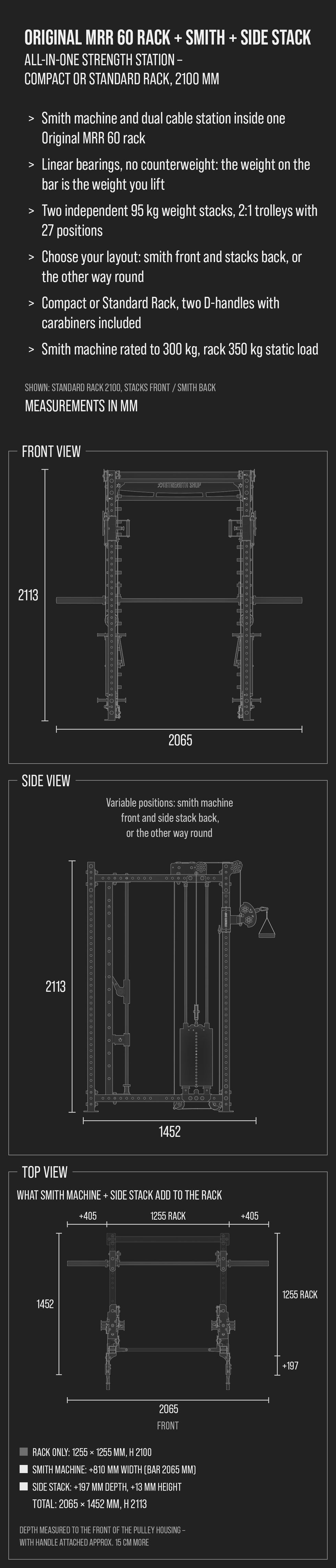
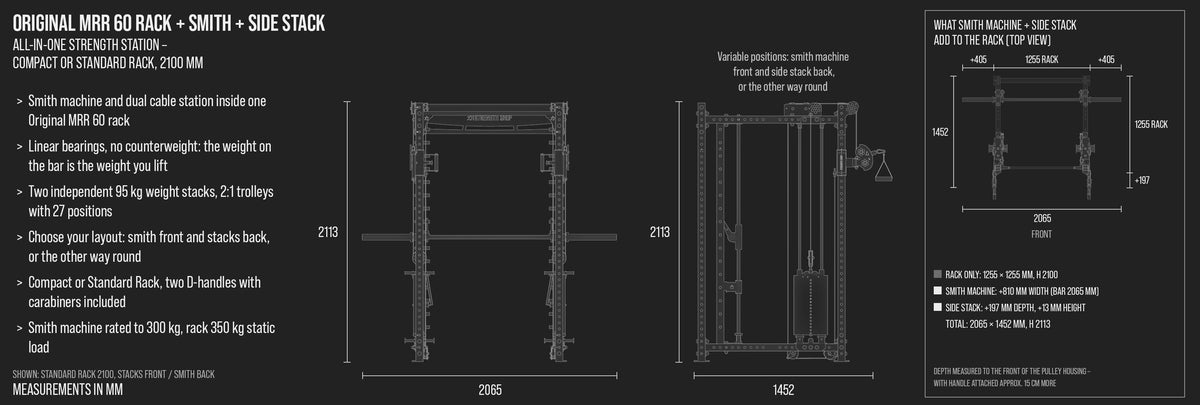
The smith machine and the stacks both mount inside the rack, and you decide which one goes where. On both the Compact and the Standard Rack you choose whether the smith machine or the stacks sit at the front. Because nothing is bolted to the outside of the frame, the station is only as wide as the smith bar.
Built on the Original MRR 60
The base is the Original MRR 60 with 60 × 60 mm uprights, a solid bolted construction and numbered holes on the front and back, so you find your settings again in seconds. Spotter arms are included. For the most stable setup, anchor the rack to the floor, especially when the smith machine and the cables get worked hard.
Which setup fits you?
1. Rack depth
- Compact Rack (690 mm side crossmembers): the smaller footprint for home gyms where every centimetre counts. Two layouts to choose from.
- Standard Rack (1075 mm side crossmembers): more room inside the rack for a bench and free movement. The same two layouts as the Compact Rack.
2. Layout
- Stacks front, Smith back (Compact and Standard): positions the cable trolleys at the front of the rack for direct access. The Smith Machine sits further back inside the rack.
- Smith front, stacks back (Compact and Standard): gives you direct access to the Smith bar from the front, which can make loading plates and positioning a bench more convenient. The cable system sits further back in the rack.
Which layout works best mainly depends on where you prefer to train, load your bar and access the cable system.
3. Height
The setup comes in one height that fits most rooms with a standard ceiling.
Key Highlights
- Smith machine and dual cable station inside one Original MRR 60 rack
- Linear bearings and no counterweight: the weight on the bar is the weight you lift
- Two independent selectorized weight stacks
- Pulley trolleys with pop pin, adjustable from floor level to overhead
- Choose your layout: smith machine at the front and stacks at the back, or the other way round
- Compact or Standard Rack, spotter arms included
- Great-value all-in-one station for home and garage gyms, PT studios, small gyms and clubs
Exercises
On the smith machine
- Squats, front squats and box squats
- Split squats, Bulgarian split squats and reverse lunges
- Flat, incline, decline and close-grip bench press (with a bench)
- Seated shoulder press
- Romanian deadlifts and rack pulls
- Good mornings, bent-over rows and upright rows
- Shrugs and standing calf raises
On the cables
- Cable flys from a high, low and mid position
- Single-arm and two-arm standing cable press
- Kneeling lat pulldowns and single-arm pulldowns from the top pulley
- Seated or half-kneeling rows from the low pulley
- Face pulls and reverse flys (with a rope attachment)
- Lateral raises and front raises
- Cable curls, triceps pushdowns and overhead triceps extensions
- Pallof press, woodchoppers and cable crunches
- Glute kickbacks and hip abduction (with an ankle strap)
Pairings for one station
- Incline bench press on the smith machine + low-to-high cable flys
- Romanian deadlifts on the smith machine + glute kickbacks
- Seated shoulder press on the smith machine + face pulls
- Bent-over rows on the smith machine + single-arm pulldowns
- Overall Dimensions (approx., W × D × H)
- Smith Machine
- Bar Position from Floor (lowest / highest)
- Usable Range of Motion
- Hook Positions
- Safety Stopper Positions
- Position Spacing
- Maximum Load
- Bar Specifications
- Compatible Plates
- Knurling and Marking Rings
- Sleeve Rotation and Guidance
- Mounting
- Side Stack Cable System
- Weight Stacks
- Weight per Stack
- Adjustment
- Cable Ratio
- Maximum Cable Travel
- Trolley Height Positions
- Pulleys
- Cable
- Included Handles
- Original MRR 60 Rack
- Rack Footprint (W × D)
- Side Crossmember Length
- Upright Height
- Uprights
- Holes
- Load Capacity
- Hardware
- Safeties
- Floor Anchoring
Smith machine at the front or at the back: how do I decide?
Think about what you use most. Whatever sits at the front is the quickest to get to. With the smith machine at the front, plates and bench are handled in no time, which suits anyone whose heavy work happens mainly on the smith bar. With the stacks at the front, the cables are the first thing you reach – a good fit if you train on the cables in nearly every session. Both layouts take up the same floor space.
Why isn't this setup available with the Half Rack?
The smith machine and the weight stacks both need space inside the rack, and the Half Rack doesn't offer enough of it for both systems. The smith machine's Front Mount can't be combined with the Side Stack either. That's why this station is built on the four-post Compact or Standard Rack, with the smith machine always mounted inside.
How much room do I need?
The footprint of each version is listed in the specifications. In terms of height, the weight stacks are the tallest part at approx. 211.3 cm, so the station fits under most standard ceilings. Allow a little extra space above for assembly and leave enough room in front of the rack to step in and out comfortably.
Why does the stack feel lighter than the weight I selected?
The cables run at a 2:1 ratio. At the handle you move roughly half of the selected weight, and in return the cable travels twice as far. That makes the pull long and even – perfect for controlled isolation work and higher rep ranges.
How much load can the station take?
The rack is rated for 350 kg (static) and the smith machine for 300 kg. Each weight stack goes up to 95 kg.
Which handles come with it, and which attachments fit?
Two D-handles with carabiners are included, so you can start with most cable exercises straight away. Any standard cable attachment with an eyelet clips onto the carabiner, for example a triceps rope, lat bar, straight bar or ankle strap.
Is the station suitable for studios and clubs, and does it need anchoring?
Yes, for many facilities. The Original MRR 60 line is a robust, cost-efficient choice for home gyms, PT studios, smaller gyms and clubs. For very high daily traffic, the Riot MRR 75 line is the heavier-duty alternative. Anchoring the rack to the floor is recommended in any case, as it gives the whole station the best stability.
See our assembly instructions for easy setup: Original MRR 60 Rack
+ Smith Machine + Original Side Stack
Two or more persons are recommended for assembly and installation.